What Is Alluvial Gold and Where It Is Found
Say a mine owner asks, 'Is this river gravel worth running through a plant?' Alluvial gold processing begins with that question, because the feed is free gold in unconsolidated sand, gravel, and clay, not locked inside hard rock. The gold occurs as flakes, grains, or nuggets that weathering has released from original veins. It then moves downhill and concentrates in riverbeds, floodplains, ancient channels, and terraces where water slows down.
The U.S. Geological Survey confirms this is not a fringe corner of the industry. In 2022, gold was produced at more than 40 lode mines in 11 States, at several large placer mines in Alaska, and at numerous smaller placer mines, mostly in Alaska and the Western States (USGS Mineral Commodity Summaries 2023). For wider context, the same agency maintains gold statistics and information on global supply and demand.
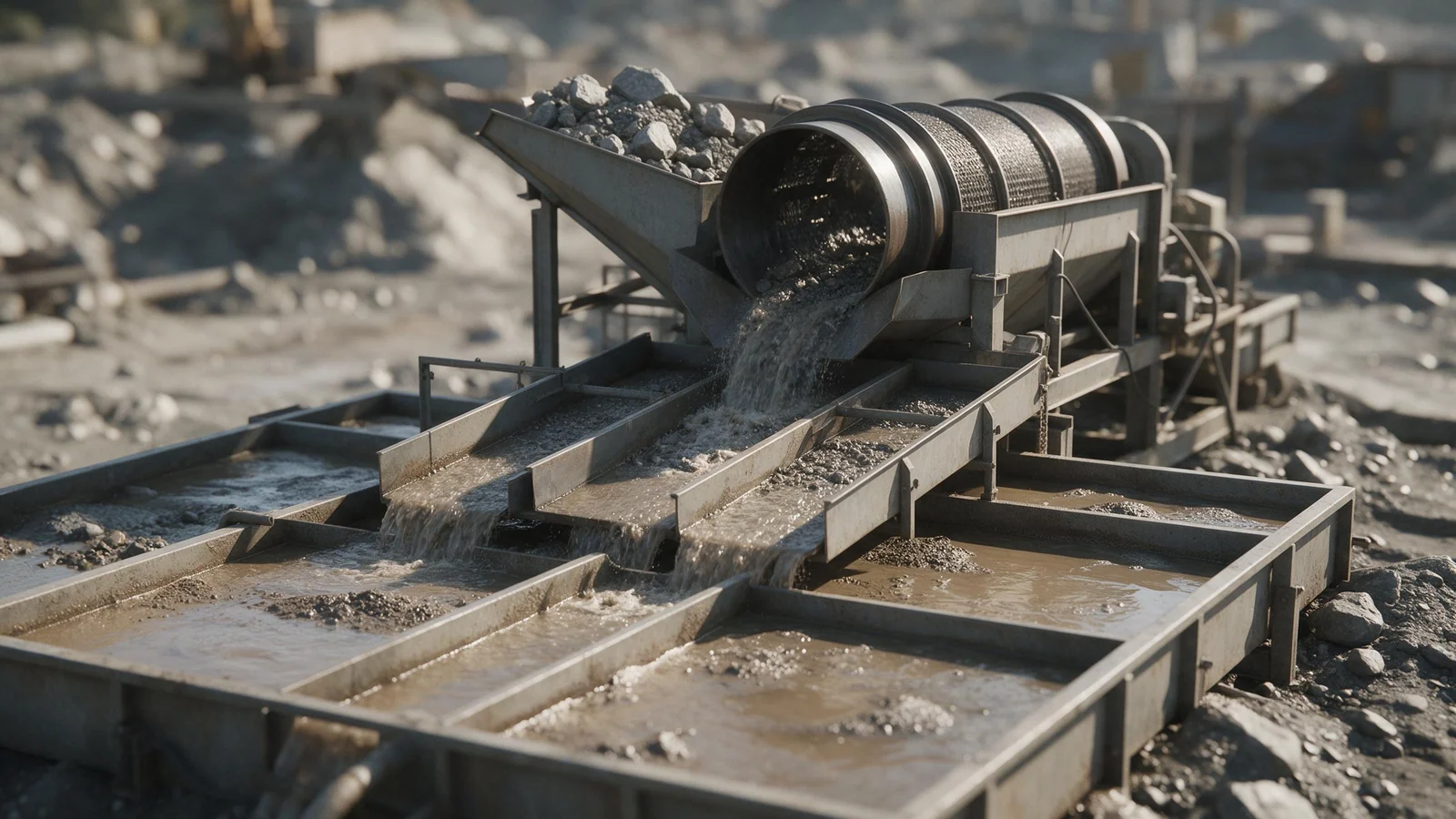
For the machinery side, a wash plant is more than a trommel. See gold trommel design and gold wash plants for details on the individual units.
Alluvial Gold Processing Flowsheet: From Feed to Gold
Once you've got a feed source, the flowsheet is short in principle. Feed, wash, screen, concentrate, upgrade. The reality is messier. Clay, root matter, and variable gold particle size will fight you at every step.
A workable alluvial gold processing plant usually follows five stages.
- Feeding and scalping to reject oversize rocks and trash before they damage downstream equipment.
- Scrubbing and washing to break down sticky clay and release trapped gold particles.
- Screening and classification to split the feed into narrow size fractions that gravity machines can handle.
- Primary gravity concentration to produce a rough concentrate, usually with sluices, jigs, or centrifugal concentrators.
- Upgrading and final concentration on shaking tables or spirals until the product is clean enough to smelt or sell.
The exact sequence isn't fixed. Some plants skip screening if the feed is clean; others add a secondary jig on screen oversize to catch nuggets larger than the screen aperture. That decision comes from characterisation, not guesswork.
You don't need cyanide or fine grinding here. The gold is already free; you just have to catch it before the tailings leave.
Scrubbing, Screening, and Classification Equipment
Clay is the enemy. If you feed sticky clay straight into a sluice, the clay balls roll through and carry gold with them. That's why a trommel scrubber sits at the front of most alluvial plants. It lifts, drops, and washes the feed, breaking down clay lumps and scrubbing particle surfaces.
After scrubbing, you screen. A trommel screen or vibrating screen separates the feed into size fractions. Oversize rocks go to a waste stack; undersize carrying the gold goes to gravity recovery.
Classification is not optional. A jig or centrifugal concentrator tuned for 2 mm particles will lose gold at 0.1 mm, and vice versa. Split the feed, and each machine works in a bandwidth it can actually manage. The exact split point depends on the gold particle size distribution, which is one of the first things a metallurgical test should establish.
For a closer look at scrubbing and screen selection, see how to size a gold trommel.
Gravity Recovery: Sluices, Jigs, and Centrifugal Concentrators
This is where the plant makes its money. The right roughing device depends on particle size and feed rate.
| Device | Best duty | What to watch |
|---|---|---|
| Sluice box | Roughing, low cost, high feed volume | Needs regular clean-up; fine gold may wash out if riffles are wrong |
| Jig | Coarse and medium particle recovery | Pulse frequency and bed depth matter more than many operators think |
| Centrifugal concentrator | Fine gold recovery | Fluidisation water and bowl speed control recovery |
| Shaking table | Final upgrading and cleaning | Slow, precise; not a high-volume rougher |
Sluices are cheap and simple. They work until they don't. Jigs give you more control and continuous discharge, which matters on a plant that runs day and night. Centrifugal concentrators pull in the fines that sluices lose. Then the shaking table cleans the concentrate.
Xinhai's gravity equipment range includes jigs, shaking tables, spiral chutes, and centrifugal concentrators, and the company reports it can supply complete main and auxiliary equipment for mines below 50,000 t/d.
Upgrading and Final Gold Recovery
A rough gravity concentrate is not a final product. It still carries heavy gangue minerals, and its gold content depends entirely on the feed. You upgrade that concentrate on a shaking table or a spiral until it's clean enough for the next step.
The final step is either smelting to doré in a small furnace or selling the concentrate to a refinery. Doré is the practical choice when you have a licensed smelter and enough volume to justify the fuel and flux. Concentrate sale works when a nearby refinery will pay for contained gold after assay.
Modern plants avoid mercury amalgamation. It's a health and environmental risk that no compliant operation needs in a gravity flowsheet.
Plant Layout and Water Management
You'll want the feed hopper and scrubber at the high point, gravity equipment downstream, and tailings at the lowest point. That lets water and solids flow downhill without extra pumping. Keep the clean-up room near the shaking table so final concentrate is not carried across the site.
Water is the real operating variable. An alluvial plant needs a steady supply of process water for washing and fluidisation. The usual circuit is: fresh water into the scrubber and jigs, process water to a settling pond, clear overflow back to the plant. You recycle most of it, not because water is precious everywhere, but because clean make-up water is often the bottleneck.
Modular plants help here. Pre-wired skids and factory-assembled steel structures drop onto a prepared pad, which cuts civil work and speeds up expansion. For an overview of that approach, see modular gold processing plant design.
How to Specify an Alluvial Gold Plant
Say you're sending a request for quotation. Don't start with 'how much?' Start with your feed.
- Clay content and stickiness. This decides scrubber length and power.
- Particle size distribution of the gold. This decides whether you need jigs, centrifugal concentrators, or both.
- Feed particle size distribution, including oversize rock. This decides screen area.
- Throughput in tonnes per hour and planned operating hours per day.
- Water availability, quality, and whether you can build settling ponds.
Then ask every supplier the same four questions.
- What recovery testwork have you run on a similar feed, and can I see the full report, not just the headline number?
- What is the specific water consumption per tonne of feed, and what is the maximum solids concentration in recycled water?
- Where do tailings go, and what is the settling pond size for my throughput?
- What is the layout footprint, and can the plant be shipped as modules?
How would you know if a supplier is bluffing? Ask for the full test report. Xinhai's mining research institute operates a CNAS-accredited laboratory covering 70+ ore types, with about 5,000 element analyses per month and Bond work index testing. That's the kind of testwork capability you should expect before someone sizes your gravity circuit.
If you want engineering and procurement wrapped into one contract, see gold processing plant EPC.
Frequently asked questions
Where is alluvial gold found?
Alluvial gold occurs in riverbeds, floodplains, ancient channels, and terraces where water has concentrated free gold particles. Weathering releases gold from source rock, then water transports and deposits the heavier flakes, grains, and nuggets in places where flow slows.
Is alluvial gold real gold?
Yes, alluvial gold is native gold metal. It is the same element as lode gold, but it occurs as loose particles rather than locked in hard rock. The gold content of a placer deposit depends on how much weathering and transportation have concentrated the metal.
How is alluvial gold processed?
Alluvial gold processing starts with feeding and scalping to reject oversize rocks, then scrubbing and washing to break down clay. Screening and classification split the feed by particle size, and gravity equipment such as sluices, jigs, and centrifugal concentrators recovers the gold. Final upgrading on shaking tables or spirals produces a concentrate that can be smelted to doré or sold.
What equipment is used in alluvial gold mining?
Typical equipment includes trommel scrubbers, vibrating screens, sluice boxes, jigs, centrifugal concentrators, shaking tables, water pumps, and settling ponds. In modular plants, these units are often mounted on skids or steel structures for fast site installation.