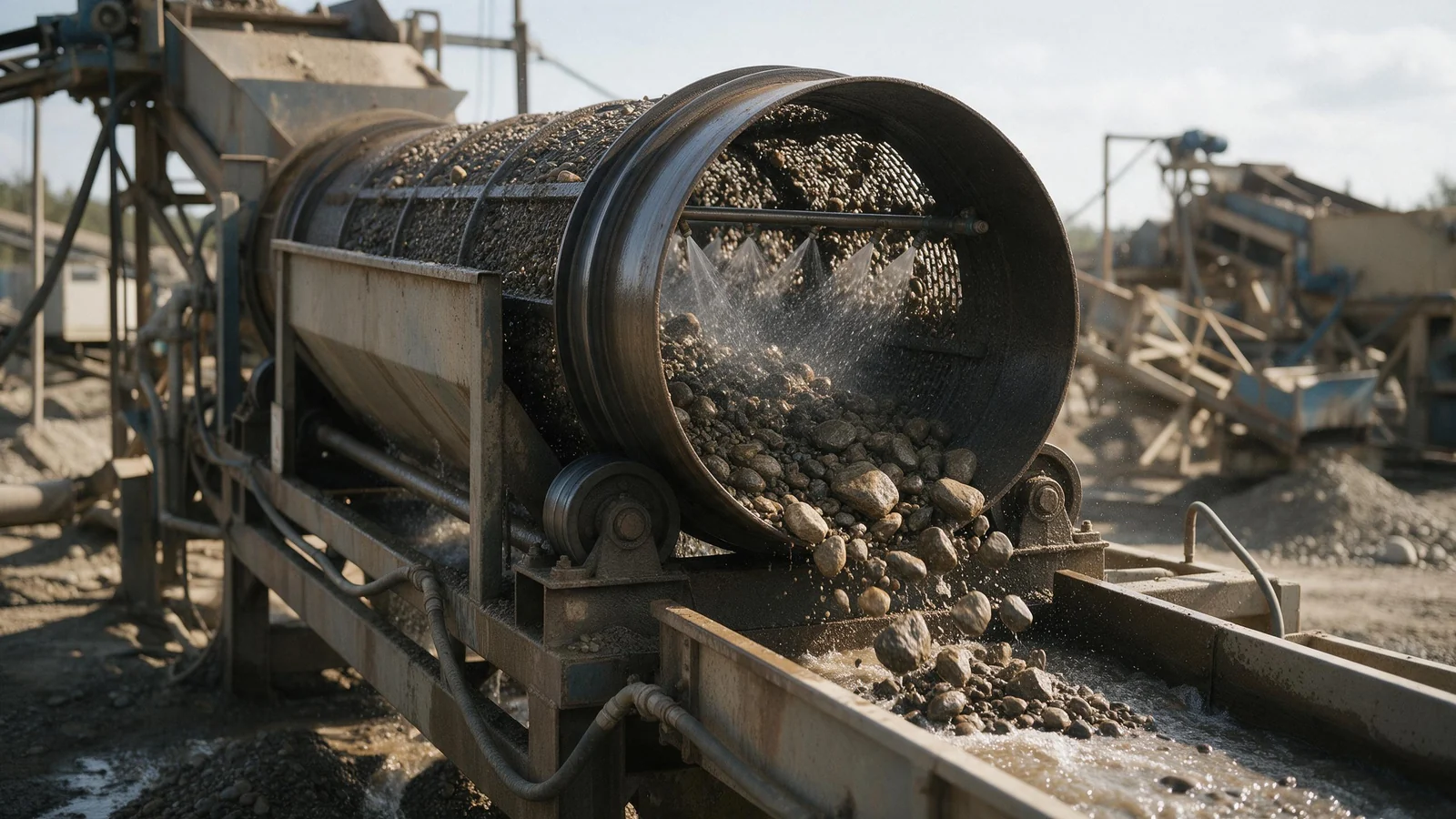
What a gold trommel does
Say a mine owner asks what a gold trommel actually does. It's a rotating cylindrical screen. You'll find it in alluvial and placer gold circuits, where it scrubs clay off gravel and splits the feed into size fractions. It sits at the front of a gold wash plant, before any sluice, jig, or centrifugal concentrator. It's a preparation stage, not a recovery device. That distinction matters when you're sizing a plant. A trommel that's too small will choke your downstream recovery. One that's oversized wastes power and water. Sounds obvious, but plenty of plants get this wrong.
The trommel rotation lifts and drops the feed inside the drum. Clay and fine material disaggregate through abrasion and impact. A water spray bar inside or outside the drum helps break clay bonds and flush fine particles through the screen openings. Oversize rocks ride the drum and discharge at the end. Undersize material falls through the screen and reports to the recovery circuit. The USGS Gold Statistics and Information page describes placer gold as detrital gold concentrated in stream gravels. That's exactly the feed a trommel is designed to prepare.
How a trommel screen separates alluvial gold feed
A trommel screen classifies material by size through a rotating perforated drum. You can break the process into five ordered steps. Feed enters the drum through a chute or hopper first. Second, the drum rotates and lifts the material, then drops it. That breaks clay lumps and frees gold particles. Third, water sprays wash the tumbling material and carry fine particles toward the screen surface. Fourth, particles smaller than the screen aperture pass through the openings and report to the recovery circuit. Fifth, oversize material larger than the aperture travels along the drum and discharges at the tail end. Same sequence whether you're running a 5 t/h pilot unit or a large alluvial plant. Why do operators forget step three? Water pressure matters more than they think.
The Canadian Institute of Mining, Metallurgy and Petroleum (CIM) describes screening as a classification step that separates particles by size. A trommel adds a scrubbing action that a flat vibrating screen doesn't provide. That's why the trommel screen gold circuit works well on clay-bound gravel.
Trommel drum sizing: matching diameter, length, and speed to the feed
Drum diameter controls the volumetric capacity and the maximum lump size you can feed. In general, the drum must be large enough to handle the largest rocks in the feed without bridging or plugging. The diameter also determines the available screen area. Drum length controls residence time. That's the time material spends inside the drum. A longer drum gives more scrubbing and screening time. A shorter drum is cheaper but may not fully break clay or screen fines. It's a trade-off you'll feel in your recovery numbers.
Rotational speed is usually described as a percentage of critical speed. Critical speed is the rotational speed at which centrifugal force on a particle at the drum wall equals the gravitational force pulling it down. If a trommel runs at critical speed, material sticks to the drum wall and doesn't tumble. Most trommels run well below critical speed to maintain a tumbling action. You don't need to calculate critical speed yourself unless you're designing from scratch. Most suppliers will confirm the right speed for your feed. Xinhai reports that its equipment range supports plants up to 50,000 t/d. That means trommel selection for large circuits often happens alongside ball mills and leach tanks.
Screen aperture selection for alluvial gold
Screen aperture is the opening size of the screen panel, measured in millimetres. For alluvial gold screening, you pick the aperture to pass the gold particles you want to recover and reject oversize gravel that would dilute the downstream recovery feed. Set it too large and too much oversize reports to the sluice or jig, reducing recovery efficiency. Set it too small and fine gold can be lost with oversize. Plus the screen may blind with clay. No single number works everywhere.
Selection follows three ordered steps. First, determine the size distribution of the gold particles in the deposit. Second, set the aperture large enough to pass all recoverable gold, plus a margin for variations. Third, check the aperture against the clay content and moisture of the feed. Sticky clay may require a larger aperture or additional spray water. Pilot-scale testing is the only reliable way to nail this down. For a small operation, you can start with the small-scale gold processing design approach and scale up after a pilot run.
Retention time, slope, and water requirement
Retention time is the time material spends inside the trommel drum. It's controlled by drum length, slope, rotational speed, and feed rate. A steeper slope shortens retention time and increases throughput but gives less scrubbing. A flatter slope extends retention time but may reduce capacity. You need enough retention time to break clay and screen fines, but not so much that the drum becomes too long and expensive. How much is enough? Testwork will tell you faster than any rule of thumb.
Water does two jobs in a gold trommel. It washes clay off gravel, and it carries fine particles through the screen apertures. Water demand depends on the clay content and the feed rate. A high-clay feed needs more water per tonne than a clean, sandy gravel. You'll often see spray bars mounted inside the drum near the feed end, with additional sprays along the length. The water must be clean enough not to clog spray nozzles. Xinhai reports it has completed 600+ EPC projects. In many alluvial or semialluvial circuits the water balance is a major design input.
When a trommel beats a vibrating screen
If your feed is sticky, clay-bound gravel, a trommel often beats a vibrating screen. That's because a trommel scrubs and screens in one step. A vibrating screen only screens. It doesn't break clay lumps. Clay can blind a vibrating screen deck quickly, cutting screening efficiency and forcing frequent shutdowns. A trommel's tumbling action and internal water sprays keep the screen surface working longer. Would you rather clean clay off a flat deck by hand? Most operators wouldn't.
A trommel is also more forgiving with oversize rocks. The rotating drum lets large rocks roll through without blocking the screen. A vibrating screen may bounce them off or trap them on the deck. The trade-off? A trommel has lower screening efficiency per unit area and a larger footprint than a flat screen for the same capacity. When the feed is dry, free-flowing, and low in clay, a vibrating screen may be the better choice. When the feed is wet and sticky, the trommel screen gold circuit is usually more robust.
A trommel is preparation, not recovery
It's worth repeating: a gold trommel is a preparation stage, not a recovery device. Nothing about the trommel concentrates gold directly. The gold that passes through the screen stays in the undersize stream, mixed with fine sand and silt. Recovery happens downstream in sluices, jigs, or centrifugal concentrators. Those devices use density differences to separate gold from the screened material. Skip the trommel and feed raw gravel straight to a sluice? You'll lose recovery because large rocks disrupt the flow and bury fine gold. The trommel's job is to deliver a clean, classified feed that the recovery equipment can handle.
This is why a trommel is always paired with a recovery circuit. In a gold recovery methods context, the trommel is part of the feed preparation, not the concentration step. Xinhai reports that its CIL/CIP circuits can reach 99% recovery on suitable ores. But that's a downstream leaching process, not an alluvial screening result. For alluvial gold, the analogous downstream steps are gravity-based.
Downstream recovery and plant integration
Once the trommel has screened the feed, the undersize slurry reports to a sluice, jig, or centrifugal concentrator. Sluices are simple and cheap but require manual cleaning or a continuous cleanup system. Jigs handle coarse gold and high throughput. Centrifugal concentrators excel at fine gold recovery. Your choice depends on the gold particle size and the plant capacity. A modular design often places the trommel directly above the recovery unit so undersize flows by gravity, saving pumping energy. Simple and effective.
If you're building a complete plant, the trommel is just one piece of the flowsheet. You'll also need feed preparation, water supply, tailings management, and gold cleanup. The same logic applies whether you're designing a gold milling circuit for hard rock or an alluvial wash plant. For larger operations, Xinhai reports it has delivered projects such as a 15,000 t/d gold processing EPC and a 4,000 t/d gold CIP plant. Both required careful feed preparation ahead of the recovery circuits.
Frequently asked questions
What does a gold trommel do in an alluvial gold circuit?
A gold trommel scrubs clay off gravel and screens the feed into size fractions. It's a preparation stage, not a recovery device. The screened undersize then goes to sluices, jigs, or centrifugal concentrators for gold recovery.
How do you choose the screen aperture for a gold trommel?
You choose an aperture that passes all recoverable gold particles while rejecting oversize gravel. The first step is to determine the gold particle size distribution from testwork. Then set the aperture slightly larger than the largest gold particle you want to recover, allowing for clay blinding and moisture.
When should I use a trommel instead of a vibrating screen?
Use a trommel when the feed is sticky, clay-bound gravel. A trommel scrubs and screens in one step, whereas a vibrating screen only screens and can blind with clay. For dry, free-flowing feed, a vibrating screen may be more efficient per unit area.
Is a gold trommel a gold recovery device?
No. A gold trommel is a preparation device. It classifies the feed but does not concentrate gold. Gold recovery happens downstream in gravity devices such as sluices, jigs, or centrifugal concentrators, or in later leaching circuits for hard rock.