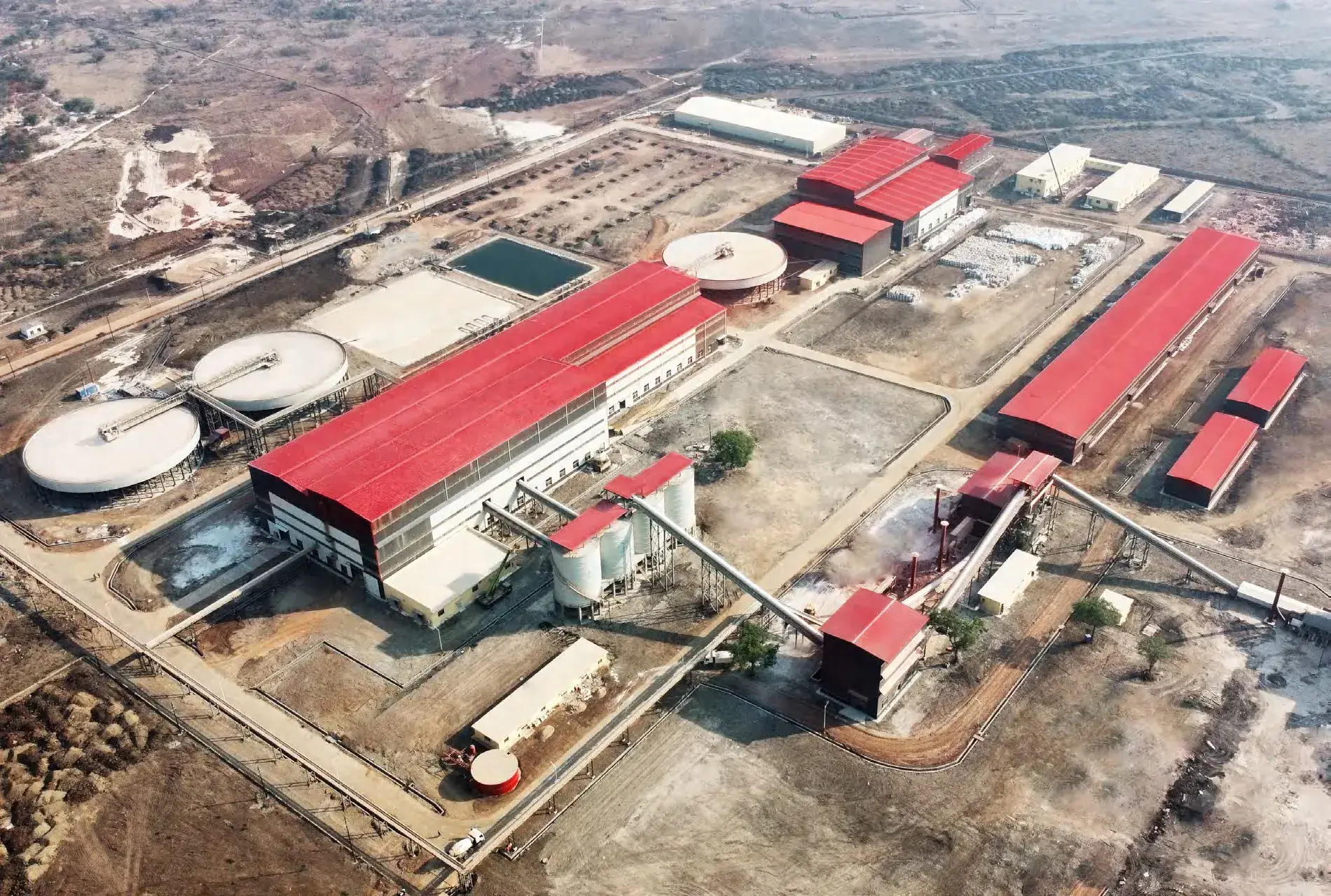
What a 500 tpd gold plant includes
A 500 tpd gold plant is a processing facility sized to crush, grind and recover gold from roughly 500 tonnes of ore per day. That throughput sits in a practical mid-range: large enough to justify a full milling circuit, small enough to permit modular construction and a faster build. Xinhai reports having delivered plants across this tier and much larger ones, using the same single-partner EPC+M+O model. You can treat a 500 t/d plant as an engineered system, not a collection of machines.
For a gold project at this scale, the plant normally includes a crushing stage, a grinding and classification circuit, and a recovery section. Recovery may be gravity, flotation, cyanide leaching (CIL/CIP) or a combination, depending on the ore. A 500 tpd plant is a common tier for mid-size operations where ore continuity justifies a dedicated milling line.
The design basis is usually stated as dry tonnes per day. If the ore contains significant moisture or clay, the wet throughput may differ, and the plant design must account for that. Xinhai's engineers use laboratory testwork to fix the flowsheet before equipment selection.
Capacity selection and modular construction
Choosing 500 t/d often reflects a balance between capital cost and operating cost per tonne. Smaller plants—say 100 t/d or less—tend to use simpler circuits, while larger plants above 1,000 t/d justify more complex automation. The 500 t/d tier sits where a fully engineered milling circuit becomes viable but modular assembly still trims site work. Xinhai's modular approach pre-assembles crushing, grinding and recovery modules in a fabrication shop, then ships them for rapid site assembly.
According to Xinhai's published capabilities, modular plants can cut construction time from months to weeks in suitable locations. The company operates three smart manufacturing bases covering about 110,000 m² and over 1,000 equipment types. That manufacturing depth supports standardised modules for a 500 tpd gold plant, but the flowsheet itself is still customised from ore data. See modular gold processing plant for more on the approach. You can also compare throughput at the 1,000 t/d tier or the 3,000 t/d tier.
Testwork, flowsheet and recovery routes
Before fixing a flowsheet for a 500 tpd gold plant, you need ore characterisation and recovery testwork. Xinhai's CNAS-accredited laboratory analyses about 5,000 elements per month and runs around 200 metallurgical tests per year. The testwork programme typically covers grindability (Bond work index), gravity recovery potential, flotation response and cyanide leach kinetics. The results decide whether the plant uses CIP, CIL, flotation or a gravity-cyanide combination. Bond work index is a laboratory measure of the energy required to grind a tonne of ore to a standard fineness.
CIL and CIP are both agitated cyanide leach circuits where activated carbon adsorbs the gold. In CIL, leaching and adsorption happen simultaneously in the same tanks; in CIP, leaching finishes before carbon contact. On suitable ores, CIL/CIP recovery can reach 99%, but that is not a promise for every ore. Compare the two routes in CIL vs CIP and review a dedicated gold flotation plant where flotation is the primary recovery method.
Equipment and manufacturing scope
| Equipment type | Typical function | Selection variables |
|---|---|---|
| Crushing (jaw/cone) | Reduce run-of-mine ore to a feed size suitable for grinding | Feed size, ore hardness, moisture, throughput |
| Grinding (ball mill) | Liberate gold particles to the target P80 | Bond work index, product size, throughput |
| Classification (hydrocyclone) | Separate ground product and return coarse particles | P80, solids density, cyclone geometry |
| Recovery (CIL tanks, flotation cells) | Concentrate or dissolve gold | Leach kinetics, reagent consumption, flotation response |
| Thickening (thickener) | Dewater tailings or concentrate | Settling rate, underflow density, flocculant dose |
Xinhai manufactures ball mills up to φ7 m, flotation cells up to 320 m³, and thickeners up to φ100 m. For a 500 tpd plant, actual equipment selection follows from testwork and mass balance, not from a catalogue. The company reports over 1,000 equipment types across three manufacturing bases and supports plants up to 50,000 t/d. A gold milling plant at 500 t/d can use pre-assembled modules to reduce on-site welding and civil work.
EPC+M+O delivery for a 500 t/d plant
EPC+M+O is an integrated service model covering engineering, procurement, construction, mine construction management and mine operation management. For a 500 tpd gold plant, that means one accountable partner from ore testwork through to commissioning and optional operation. Xinhai has reported delivering 600+ EPC+M+O projects across 100+ countries, with 2,500+ mines served. Those figures are the company's published self-assessment.
The engineering phase includes detailed design to standards such as JORC and NI 43-101 where applicable. The procurement phase covers equipment manufacturing, packaging and shipping. Construction includes civil works, steel structures, installation and commissioning. The M+O phases cover mine construction management and production operation. You can engage all phases as a single contract or use a modular scope. See gold processing plant for the wider solution.
Reporting standards and cyanide compliance
If you plan to raise capital or list a project, mineral resource and reserve reporting normally follows the JORC Code or NI 43-101. Xinhai's design institute holds a Class B metallurgical engineering qualification in China. That is not a substitute for a Competent Person's sign-off under JORC or a Qualified Person's report under NI 43-101, so local regulatory advice is still necessary. See the JORC Code and NI 43-101 for reporting standards.
Cyanide leaching on a 500 tpd gold plant is serious chemistry, not a catalogue item. The International Cyanide Management Code is a voluntary industry programme covering production, transport, storage and use of cyanide. Signatory operations are certified through third-party audits. Any plant using cyanide must follow local safety and compliance procedures. Xinhai's designs include cyanide detoxification and tailings management, but the operating permit and code compliance remain the owner's responsibility.