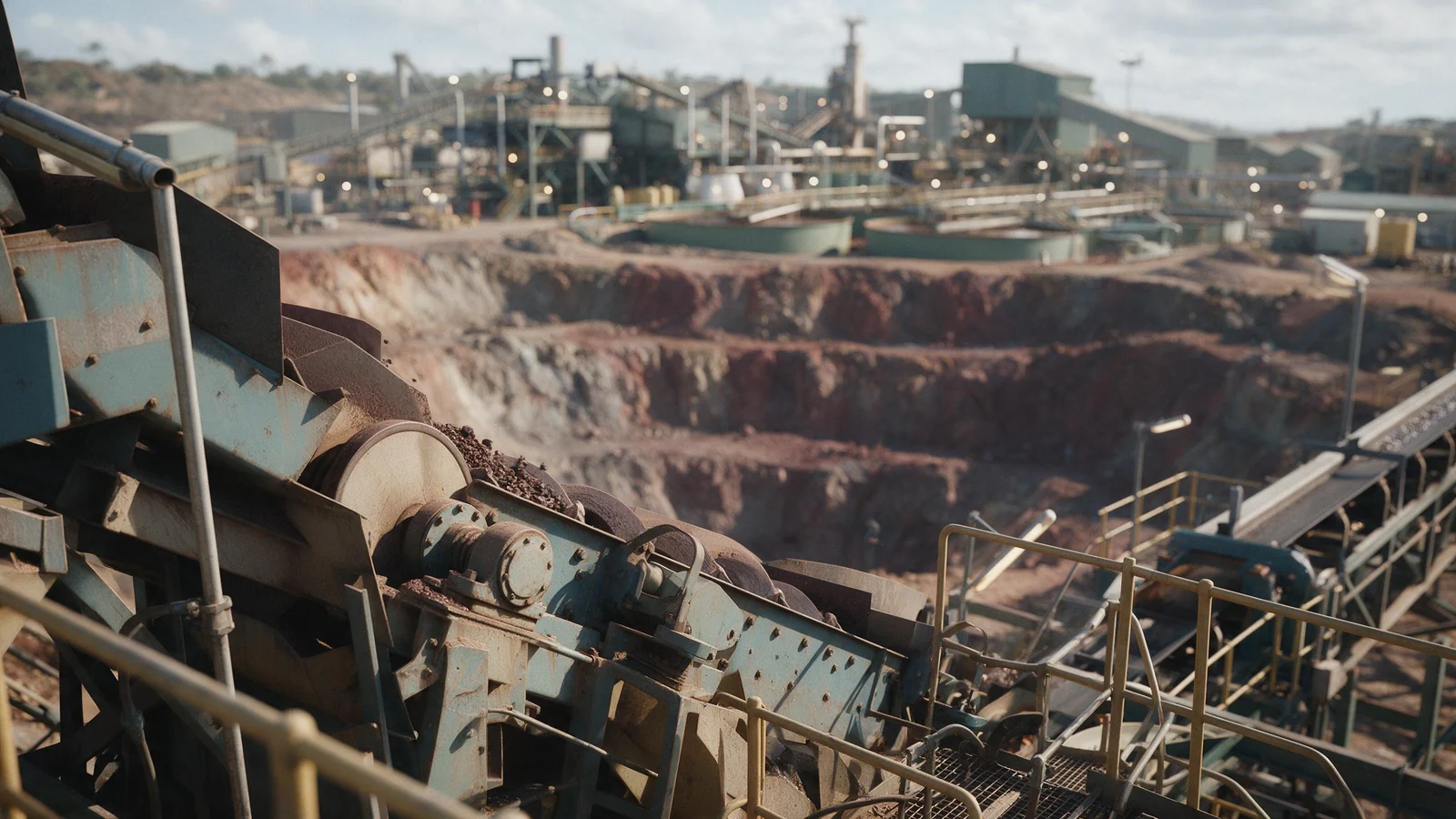
Say a mine owner asks why one oxide gold ore can be heap leached while the next one has to be milled. The answer rarely sits in the gold grade alone. It sits in three properties you can measure before a flowsheet is drawn: how free the gold is, how much clay the ore carries, and where the oxide-to-sulfide boundary actually sits. In 2022 domestic gold mine production was estimated at 170 tons, according to the USGS Mineral Commodity Summaries.
What Oxide Gold Ore Is and Why It Processes Differently
Oxide gold ore is not a chemical compound of gold and oxygen. It is weathered rock in which sulfide minerals have broken down near the surface, leaving iron oxides, quartz and clay minerals behind. The gold stays as metallic gold, but the host has changed. Limonite, hematite and goethite are common. So is clay. That matters, because the gold in a true oxide zone is often free or exposed at a coarse size. You don't need roasting. You don't need pressure oxidation. You usually need less energy in the mill and a simpler leach circuit. That is a different problem from refractory gold ore, where the gold is locked inside sulfides and needs oxidation first.
Characterising the Feed: Grade, Clay, and Mineralogy
Field identification is the cheap first step. Oxide ore usually shows rusty yellow-brown surfaces, a porous texture, and it crumbles more easily than fresh sulfide rock. Don't trust that alone. You need a laboratory answer. Clay content is the biggest single variable in plant design. A little clay and you can crush, stack and leach. A lot of clay and you'll blind a heap, choke a thickener and lose gold in slimes. Xinhai's mining research institute operates a CNAS-accredited laboratory that covers 70+ ore types, performs about 5,000 element analyses per month, and offers Bond work index testing. That kind of testwork is where a flowsheet should begin. Mineralogy tells you whether the gold is free, attached to limonite, or trapped in remnant sulfides. Grade tells you which route to consider first, but grade alone doesn't decide.
Crushing and Grinding: Liberating Gold Without Overgrinding
Staged crushing with screens in closed circuit controls what reaches the grinding circuit. You don't want the mill fed with oversize. Oxide ore is generally softer and less energy intensive than sulfide ore, so a single stage crushing plant can often feed a SAG or ball mill directly. The key is not to grind finer than the gold needs. Overgrinding turns oxide ore into slime, which is difficult to settle and bad for heap permeability. For a leach feed, you only need enough size reduction to expose the gold. Many oxide plants set the grind below 200 mesh and then let bottle roll tests tell them whether that is fine enough. The exact passing percentage comes from testwork, not from a catalogue. Ball mill selection for oxide feed is discussed in ball milling gold processing.
Heap Leach or Mill: Choosing the Plant Route
The route decision is not an ideology. It's an exercise in matching three things: grade, clay and topography. Lower grade, permeable oxide ore usually goes to a heap leach. Higher grade or clay heavy ore usually goes to a mill and CIL/CIP circuit, because clay will blind a heap and you can't risk losing the gold. Agglomeration can improve heap permeability for clay-bearing oxide ore. You mix the crushed ore with cement or lime, roll it into stable agglomerates, and stack it so the leach solution can actually percolate. If the pit is steep or space is tight, a compact milling plant often fits better than a large heap pad. Which route fits your ore?
| Decision factor | Heap leach | Mill + CIL/CIP |
|---|---|---|
| Typical ore | Lower grade, permeable, low clay | Higher grade, clay heavy or fine grained |
| Gold recovery expectation | Usually lower, depends on percolation | Usually higher for oxide ore |
| Grinding requirement | Crush only, no fine grinding | Grind to a controlled pulp size |
| Clay handling | Washing, desliming or agglomeration needed | Desliming or viscosity control in the leach tanks |
| Topography | Needs a large, gently sloping pad | Compact footprint, suits steeper sites |
| Operational control | Weather sensitive, longer leach cycle | Steady state plant, faster carbon recovery |
Topography matters more than most owners expect. A heap leach pad needs a large, flat or gently sloping area with good drainage. A mill and agitated leach circuit can sit on a smaller bench and is less exposed to rainfall. If your site has a short dry season, a mill may keep running while a heap pauses. That operational difference often outweighs the initial equipment comparison. If you're weighing a heap against a mill, the modular gold processing plant option shows how a compact mill circuit can be assembled quickly without the large earthworks of a pad. You can still run a gold processing plant with a hybrid circuit: crush, agglomerate, heap leach the low grade, and mill the high grade. Many operations do exactly that.
CIL/CIP and Cyanidation for Oxide Gold Ore
Cyanide leaching dissolves metallic gold from oxide ore without any pre-oxidation step. Activated carbon then recovers the gold from the pregnant solution, either by carbon-in-pulp (CIP) or carbon-in-leach (CIL). For a well liberated oxide feed, recovery can reach 99 per cent, but that is a laboratory or design target, not a guarantee on every ore. Oxide ore generally achieves higher recovery than refractory sulfide ore because the gold is already exposed and the cyanide doesn't have to fight sulfide minerals first. That freedom is exactly why we test the ore before promising anything. You can read more about the leaching step in gold leaching.
Cyanide management is not an afterthought. The International Cyanide Management Code is intended to promote safe and environmentally responsible management of cyanide used within the gold and silver mining industry. Tailings treatment, detoxification and water balance belong in the plant design from day one. You'll need carbon screens, air lifters, desorption electrolysis and carbon regeneration as part of the circuit, and they all have to handle the clay and slimes that oxide ore produces. Twin impeller leaching agitation tanks are the workhorse for keeping pulp and carbon in suspension.
Designing for the Oxide-to-Sulfide Transition
The oxide-to-sulfide transition is where many plants quietly lose recovery. A pit starts in oxide, then a few metres deeper the ore changes colour and the leach tails stop matching the design curve. Transition ore contains increasing sulfide content, often as pyrite or arsenopyrite. The gold starts to lock inside those sulfides, so cyanide alone won't reach it. You may need flotation, ultrafine grinding, or even oxidation before leaching. That changes the plant, not just the reagent.
Plan for that boundary from the beginning. You can design a circuit that blends transition ore with oxide ore for a few years, or you can leave space for a flotation bank and a tailings treatment line. The reagent choice also shifts: cyanide consumption rises with sulfide content, and lime demand climbs. Recovery expectations should be reset with each new bench test on transition samples. If you don't sample the transition zone early, you'll discover the boundary as a falling recovery curve, not as a design input. This is one of the least well documented questions in oxide gold ore plant design, and it's where most ranking pages go thin.
Pilot and Laboratory Testing Before Plant Design
Before you commit to a plant, run the full test ladder: exploratory, condition, open circuit, closed circuit, and semi-industrial continuous tests. Each level answers a different question. The closed circuit test tells you how recycled middlings behave. The semi-industrial pilot tells you whether clay will build up in the leach tanks or whether the heap will actually drain. Bond work index testing supports grinding equipment selection: a soft oxide ore and a hard transition zone can use the same mill but need different power calculations. Xinhai's design institute designs to JORC, NI 43-101, VALMIN, GB, Eurocodes, US and Australian standards, and holds a Class B metallurgical industry design qualification. That means the test data feeds directly into a design package rather than being treated as a side study.
Frequently asked questions
What does oxide gold ore look like?
It usually has rusty yellow-brown surfaces and a porous or crumbly texture. You'll often see limonite, hematite, goethite, quartz and clay. The appearance alone doesn't confirm the ore is oxide; laboratory mineralogy is needed.
What is the difference between oxide gold ore and sulfide gold ore?
Oxide gold ore is weathered rock where sulfides have broken down near the surface, leaving iron oxides, quartz and clay. Gold is often free or exposed, so it can be leached directly. Sulfide gold ore contains pyrite or arsenopyrite that locks gold, often requiring flotation, roasting or pressure oxidation first.
How do you process oxidised gold ore?
Most flowsheets use staged crushing and grinding, then either heap leaching for lower grade permeable ore or milling plus CIL/CIP for higher grade or clay heavy ore. Agglomeration helps heap leaching when clay is present. Testwork determines recovery and reagent consumption.
Is oxidised gold ore easier to process than sulfide ore?
Generally yes, because the gold is exposed and does not need pre-treatment. It can reach high recovery in cyanide leaching without roasting or pressure oxidation, but clay, grade and transition zones still complicate the flowsheet. Each ore must be tested.