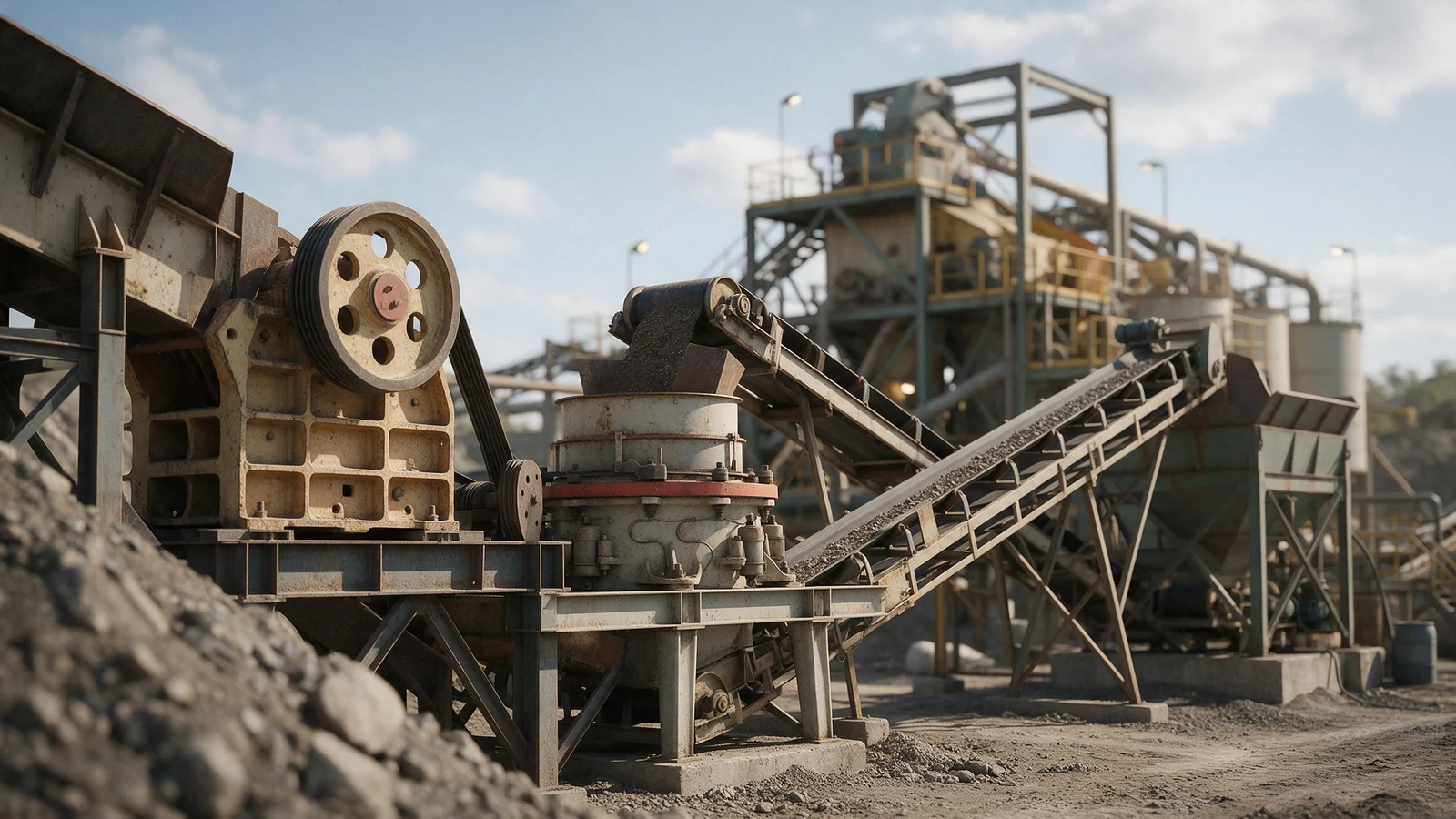
Say a mine owner asks, "What gold ore crusher do I need for my plant?" The honest answer is never one machine. It's a circuit. You'll usually start with a jaw crusher on run-of-mine ore. A cone crusher follows as secondary or tertiary. Screening keeps the top size in check and closes the circuit. Without that closed loop, you'll either overwork the mill or blind a heap leach pad.
How a gold ore crushing circuit is configured
Comminution, as the CIM Practice Guidelines define it, is the process of reducing mined material from a coarse size to a finer size suitable for concentration or extraction. For gold that usually means a jaw crusher first. Run-of-mine ore, even from an underground stope, rarely arrives below 500 mm. A jaw takes that lump and reduces it to something a cone crusher can handle. The cone then closes the gap to a product that a screen can control.
Closed-circuit crushing is the part most small operations miss. You crush, screen, and return the oversize. That single loop prevents the mill from receiving rocks it can't grind efficiently. It also stops a heap leach pad from losing permeability under a load of fines. You don't need a third crusher. You need a screen and a conveyor that returns the top size.
Think of the circuit as a size sorting machine with a crusher attached. The screen aperture sets the top size. The crusher setting sets how much reduction happens each pass. Get those two variables right and the rest of the plant follows.
Crushing for heap leach vs crushing for milling
The same ore can need a completely different crush depending on where it goes next. A heap leach wants a coarse, permeable pile. A ball mill wants a fine, controlled feed. That one decision changes crusher selection, screen size and whether you run open or closed circuit.
Heap leach operations often treat average ore grades around 0.05 ounce of gold per ton, according to a published EPA review of heap leaching practices. That doesn't change how you crush, but it does reinforce why you can't waste energy over-crushing low-grade rock. A heap needs channels for cyanide solution to percolate. Heap leaching design starts with that permeability. Crush too fine and the heap turns into a mud blanket. Solution short-circuits and recovery drops.
A milling circuit is different. Grinding is the most energy-hungry step in the whole plant, often a large portion of the power bill. Crushing is cheaper per tonne than grinding. So you crush finer before the mill, within reason. The mill then sees a smaller top size and consumes less steel and power per tonne of gold produced.
| Parameter | Heap leach | Milling |
|---|---|---|
| Crushed product target | Coarse enough to keep heap permeability | Finer to reduce grinding energy |
| Primary driver | Cyanide solution percolation and air distribution | Mill breakage efficiency and liner life |
| Typical circuit | Open circuit, often primary only | Closed circuit with screens |
| Oversize handling | Usually not recirculated if top size is acceptable | Returned to the crusher |
That table is a starting point, not a design. The final choice depends on ore hardness, clay content and the gold's particle size. Which brings us to liberation.
Liberation and coarse gold: why crushing strategy matters
Gold is malleable. It doesn't shatter like quartz. Crushing doesn't break gold into smaller gold particles, it liberates gold from the host rock. If your ore carries coarse gold, over-crushing is a trap. A cone crusher in closed circuit can flatten gold particles into flakes that then report to the wrong stream or get lost in grinding. No recovery process fixes a flattened gold particle.
Before you choose a crusher, you need to know the gold's size distribution. That's not guesswork. It's testwork. A few kilos of drill core through a laboratory jaw crusher and screen analysis will tell you where the gold sits. That's why a mineralogy and liberation study belongs upstream of flowsheet design. Gold ore testwork is the cheapest insurance you can buy.
Coarse gold recovery methods, like gravity concentration or a simple screen ahead of leaching, can pull gold out before fine grinding. If you crush too fine too early, you'll smear that gold into slimes. Then you're chasing it with cyanide and hoping. Don't.
Key crusher types for gold plants
Jaw crushers handle primary duty. They're forgiving, simple and cheap to maintain. Catalogue families cover a wide span: PE feed openings from 80 to 1200 mm and capacities from 0.5 to 600 t/h, PEX feed openings from 120 to 250 mm at 8 to 80 t/h. But those are vendor catalogue ranges, not a match for your ore. Every jaw setting changes the product curve.
Cone crushers are the workhorses of secondary and tertiary crushing. They produce a more cubical product and allow finer closed-side settings than a jaw. You'll see them in almost every milling circuit. A shorthead cone or a high-speed cone can take a 100 mm feed down to 10 mm or less, depending on the chamber.
Gyratory crushers suit very large continuous primary duty. If you're designing a very large plant, a gyratory may be the only sensible choice. They handle higher throughputs than jaw crushers and accept larger trucks. For most gold plants below a few thousand tonnes per day, a jaw is enough.
HPGR, high pressure grinding rolls, are an option for hard rock fine crushing. They use interparticle breakage and can produce a product with microcracks that reduces downstream grinding energy. But HPGR needs dry feed, careful control and a higher capital budget. Don't pick one just because it's modern. Pick it because the testwork says it pays.
Screening and feeding in a crushing circuit
Pre-screening before the crusher removes fines that don't need crushing. That saves liner wear and crusher power. It also keeps wet clay from packing the chamber. A vibrating grizzly or a punch plate ahead of a jaw does this job.
Check screening after the crusher is what closes the circuit. The screen aperture becomes your product top size. If the screen is too coarse, the mill sees big rocks. If it's too fine, you recirculate too much and choke the circuit. Screen efficiency drops when feed is wet or sticky, so you need to plan for blinding.
Feeders matter more than most people think. A jaw crusher doesn't like a surge of lumpy feed. An apron feeder or vibrating feeder under the bin delivers a controlled stream. If the feed fluctuates, the crusher chokes or runs empty. Both waste energy and hammer the liners. The goal is a steady, metered feed that matches the crusher's capability.
Selection variables for gold ore crushers
Start with the maximum feed size. Your crusher's feed opening must typically be at least 20 per cent larger than the largest rock you'll shovel into it, or the rock hangs up. Then set the target discharge opening. That comes from the downstream process: mill feed size or heap leach permeability.
Ore hardness and abrasiveness decide liner life and power. A hard, abrasive ore wears jaw plates and cone mantles quickly. You'll budget for more liner changes and maybe choose a slower speed. Moisture and clay content are equally important. Wet sticky ore plugs screens and chokes cone crushers. In that case you might need a scrubbing stage or a different screen media.
Hourly throughput determines crusher size. Don't size a crusher for peak day; size it for the design feed rate with some margin. A crusher running well below capacity wastes power and liner life. One running near full capacity will trip on overload. Open circuit vs closed circuit changes the product size distribution entirely. Closed circuit gives you a controlled top size. Open circuit gives you a wider spread, which can be fine for heap leach but not for a mill.
These variables are the same ones a good vendor will ask you about. They're not secrets. Gold ore milling depends on the same numbers, just one step downstream.
From crushing to gold recovery: next steps
Crushed product feeds grinding, classification or heap leach. If it's a mill, the crushed ore joins water and steel in a ball mill and the real size reduction begins. CIL plants can recover up to 99 per cent of the gold in suitable ores, but only if the upstream crush and grind exposed the gold in the first place. You can't leach a particle you never liberated.
Testwork and process calculation should confirm the final crusher selection. A pilot campaign or at least a locked-cycle test on your own ore beats any catalogue claim. Xinhai reports serving 2,500+ mines and 70+ ore types, according to the company's published figures. That breadth matters less than the specific test on your drill core.
The crusher is not the end. It's the first paid employee in a line of machines that turns rock into bullion. Choose it with the same care as your leach tanks.
Frequently asked questions
What is the best rock crusher for gold mining?
There isn't a single best. It depends on feed size, throughput and downstream process. A jaw crusher is usually the primary choice, a cone crusher for secondary or tertiary in a milling circuit. If the ore goes to heap leach, a single jaw may be enough. Ask any supplier for a breakage test on your ore before choosing.
How to crush rock for gold?
Start with a jaw crusher to reduce run-of-mine rock to a manageable top size. Screen out fines before crushing. If you need finer product for milling, add a cone crusher in closed circuit with a screen. The screen returns oversize to the crusher until all material passes the target size. Test the ore first to know its hardness and clay content.
How much does a gold ore crusher cost?
We can't give a price here. Crusher cost depends on capacity, feed opening, motor size, liner material and whether you need a full circuit with screens and conveyors. A small laboratory jaw costs far less than a large gyratory with a foundation and drive. Ask a vendor for a budget quote after you know your tonnes per hour and feed size.
What size should gold ore be crushed to before heap leaching or milling?
It depends on liberation size. For heap leaching, you crush coarse enough to keep permeability, usually fine enough that gold is exposed but not so fine that the heap blinds. For milling, you crush to a top size that the mill can handle efficiently, often set by a screen aperture. The right size comes from testwork, not a rule of thumb.