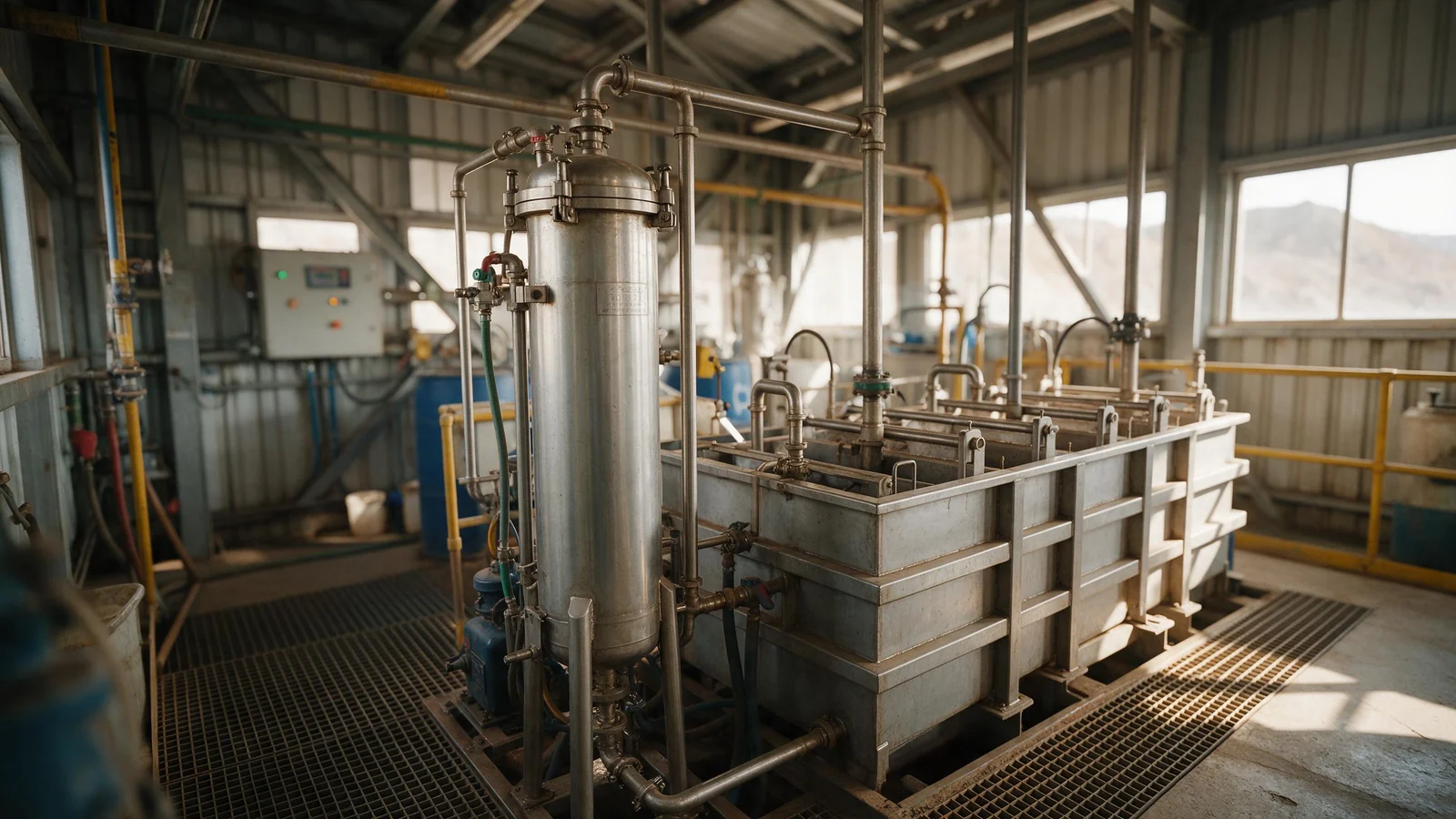
Say a mine owner asks what gold elution actually does after carbon adsorption in a gold leach circuit. Gold elution is the step that reverses loading. It takes gold cyanide complex off activated carbon and puts it into a hot, caustic solution. You can't plate gold onto a cathode while it's still stuck to carbon. So elution is the bridge between adsorption and electrowinning. Get this step wrong and every kilogram of gold left on stripped carbon goes back to the kiln, or worse, leaves the circuit as a loss.
What Gold Elution Does in a CIP/CIL Circuit
In a CIP or CIL circuit, activated carbon adsorbs gold from the pregnant leach solution. The carbon leaves the adsorption tanks loaded with gold. Elution must reverse that process. The gold cyanide complex moves from the carbon's pore surfaces back into solution. That sounds simple, but it's a chemical equilibrium you have to push hard. Heat, alkalinity, and free cyanide all work to shift gold off the carbon. If the elution step leaves residual gold on the carbon, that residual gold becomes a direct recovery loss. So elution performance sets the ceiling on final gold recovery. You can't smelt gold that never left the carbon.
How Loaded Carbon Is Stripped: The Core Process Steps
Loaded carbon first goes through an acid wash. This step removes calcium, magnesium, and other inorganics that would otherwise foul the elution column and the electrowinning cell. After acid washing, the carbon is dewatered. Then heated caustic-cyanide eluent is pumped through the column. The eluent is a solution of sodium cyanide and sodium hydroxide in water. It complexes with the gold and carries it out of the carbon pores. The resulting pregnant eluate is collected in a tank and transferred to electrowinning. Each of these steps is sequential, and skipping the acid wash is a common cause of scale and poor strip efficiency. Before you strip a batch, a loaded carbon assay is worth checking. The fire assay collection and gravimetric measurement covered by ASTM E1568 gives you a baseline for how much gold should leave the carbon.
Acid washing is not optional. The acid dissolves calcium carbonate and other scale-forming salts. If these salts stay on the carbon, they migrate to the eluate and then to the electrowinning cell. Dewatering after acid wash removes free acid and rinse water, so the eluent isn't diluted. The heated eluent must reach every carbon particle. Channelling inside the column lets eluent bypass pockets of carbon, leaving gold behind. Good column design includes proper flow distribution and a way to confirm the batch is uniformly contacted.
Zadra vs AARL and Continuous Elution
Three stripping methods dominate industrial practice: Zadra, AARL, and continuous counter-current elution. They differ in pressure, temperature, reagent contact, and cycle time. Matching the method to your carbon movement rate is more important than picking the newest name.
| Feature | Zadra | AARL | Continuous |
|---|---|---|---|
| Operating mode | Batch, atmospheric | Batch with presoak | Continuous counter-current |
| Reagent contact | Heated caustic cyanide solution recirculated | Presoak in hot caustic cyanide, then hot water elution | Carbon and eluent move in opposite directions |
| Cycle time | Longer | Shorter | Shortest for a given carbon flow |
| Typical fit | Smaller batch operations | Batch operations needing quick turnaround | Larger plants with steady carbon movement |
Zadra runs at atmospheric pressure and lower temperature. AARL adds a presoak step with hot caustic cyanide, then uses hot water to strip. Continuous elution suits plants that move carbon daily and need a steady strip rate without large batch columns. The choice is not about which method is "better" in absolute terms. It is about which method fits your batch size and your operator roster. Zadra's lower temperature and atmospheric pressure make it mechanically simpler, but its cycle times run longer. AARL's presoak takes more reagent moves but shortens the strip. Continuous elution removes the batch boundary, but it demands a stable carbon feed and tighter instrumentation. If your plant has irregular carbon movements, a continuous system may sit under-utilised.
Electrowinning: Turning Eluate into Gold Sludge
The pregnant eluate flows to an electrowinning cell. Electric current passes between anodes and cathodes. Gold plates onto the cathode, usually as a sludge or sponge, while other metals may also deposit if they are present. The gold sludge is washed, dried, and then smelted into doré. The concentration of gold in the eluate matters a lot. A weak eluate means low plating efficiency and wasted power. A strong, clean eluate plates faster and leaves less gold in the barren solution. This is the downstream half of a gold CIL plant. Operators who skip eluate quality checks often find their electrowinning cell becomes a bottleneck instead of a recovery stage.
Carbon Regeneration and Reuse
After elution, the carbon still holds organic foulants and some inorganics. Thermal reactivation in a kiln burns off the organic matter. The acid wash earlier removed many inorganics, but a periodic acid wash after thermal reactivation can help. Regeneration restores the adsorption capacity. Without it, carbon activity declines, and the adsorption circuit loses efficiency. Carbon is not a consumable to throw away after one use. It is a working medium that must be regenerated. You'll get more consistent adsorption if you treat regeneration as part of the circuit, not an afterthought. Regeneration kilns need temperature control. Too little heat leaves organics behind. Too much heat damages the carbon structure. Operators often track iodine number or other activity indicators to confirm the carbon is coming back to full adsorption capacity. You don't need to be a chemist to see the pattern: clean carbon adsorbs, dirty carbon leaks gold.
Sizing an Elution System Around Carbon Movement
Say a plant advances 10 tonnes of loaded carbon in a day. The elution system must strip that batch in a defined cycle, not process 10 tonnes per day as a continuous feed. Batch size follows carbon movement. You need to know how many tonnes of carbon leave the adsorption circuit in each movement, and how often you want to strip. Column volume is set by the carbon batch volume plus freeboard. Cycle time is set by the elution method and reagent strength. If your elution rate cannot keep up with carbon movement, carbon inventory builds up, and gold left on carbon rises. Matching elution rate to adsorption rate avoids bottlenecks.
- Carbon batch mass per strip
- Bulk density of the carbon
- Desired cycle time
- Eluent flow rate and temperature
- Number of strips per day
You don't start with a catalogue and pick a column. You start with carbon inventory and work backwards. If a supplier quotes you a capacity without asking about your carbon movement, ask them how they arrived at it. Column volume is not the same as eluate tank volume. You can have a large eluate tank and a small column, but the column must hold the carbon batch. Freeboard is required to allow eluent expansion and gas release. Under-sizing a column to save capital usually costs more in lost gold and extra strips.
Safety and Control Points in an Elution Circuit
Cyanide-based gold processing involves toxic chemicals and occupational health risks. No article replaces a compliance design and safety operating procedure. In the United States, mine safety rules sit in Title 30 of the CFR, Mineral Resources, Chapter I. Operators must treat every elution circuit as a confined space with hazardous reagents. Caustic is corrosive. Cyanide is toxic. High temperature and pressure add energy to the system.
Watch column temperature, pressure, flow, and pH. These four variables control the strip chemistry. A drop in temperature slows elution. A pressure spike may signal a blocked screen or overpacked column. Low flow starves the carbon of fresh eluent. pH outside range changes cyanide speciation and gold dissolution. Log these points every shift. Consistency in logging matters more than the exact logging format. Instrumentation should include temperature transmitters, pressure gauges, flow meters, and pH probes. Set alarms for high pressure, low flow, and high temperature. Don't rely on a single point. Redundant sensors on critical loops prevent a failed transmitter from letting a column run blind. Regular calibration of pH probes in cyanide service is not a nice-to-have; it's what keeps the readings honest.
For equipment suppliers, ask how their management systems handle cyanide and caustic reagent control. Shandong Xinhai Mining Group Co., Ltd. holds ISO 9001:2015, ISO 14001:2015, and ISO 45001:2018 management system certifications. That tells you the supplier has a management framework, but it doesn't replace your own site procedures.
Sizing is not about a catalogue's rated capacity. It's about carbon movement and strip cycle. Get the carbon flow right, and the elution circuit becomes a steady-state process instead of a weekend bottleneck.
Frequently asked questions
What is an elution plant for gold?
An elution plant is the section of a gold recovery circuit where loaded activated carbon is stripped of its adsorbed gold. It usually includes an acid wash stage, a heated elution column, and tanks for the pregnant eluate. The stripped carbon then moves to regeneration while the gold-rich solution goes to electrowinning.
How does the gold elution process work?
Loaded carbon is first acid washed to remove inorganics, then dewatered. A heated caustic-cyanide solution is pumped through the carbon column. The solution complexes with gold and pulls it off the carbon pores into the eluate. The pregnant eluate is collected and transferred to electrowinning, where electric current plates the gold onto cathodes.
What is the difference between Zadra and AARL elution?
Zadra elution operates at atmospheric pressure and lower temperature, with the heated caustic-cyanide eluent recirculated through the carbon. Cycle times tend to be longer. AARL adds a presoak step in hot caustic cyanide, then strips with hot water. This shortens the overall cycle and is useful when faster carbon turnaround is needed.
How is carbon regenerated after gold elution?
Stripped carbon is heated in a kiln to remove organic foulants. The earlier acid wash has already removed many inorganic deposits. Thermal reactivation restores the carbon's adsorption capacity. Some circuits add a periodic acid wash after regeneration. Without regeneration, carbon activity falls and the adsorption circuit leaks gold.